

You might feel confident presenting at work, but still believe you’re not good enough as a person
Or maybe you know you deserve love and respect, yet freeze up when asked to give a toast at a friend’s wedding. These aren’t contradictions; they show how self esteem vs self confidence work as separate parts of your psychological makeup.
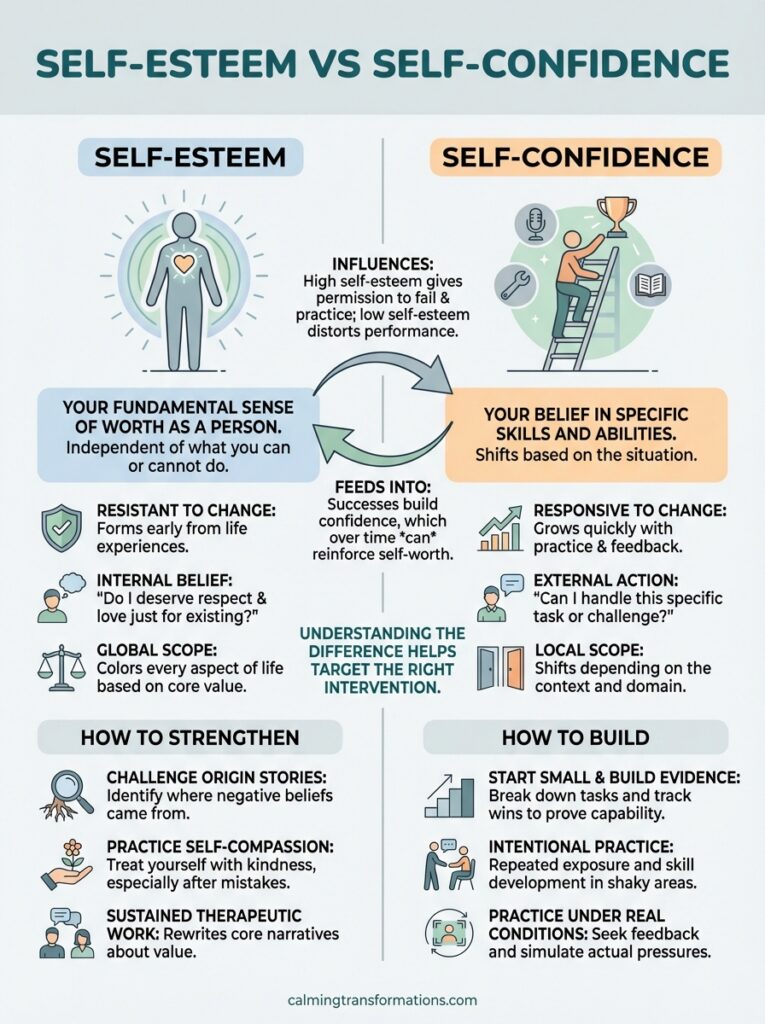
People often swap these terms like they mean the same thing, but understanding the difference actually matters. Self-esteem is your overall sense of worth as a human being. Self-confidence is your belief in specific skills and abilities. One sits at your core; the other shifts based on the situation. Mix them up, and you might spend years building skills when the real issue is how you value yourself, or the other way around.
At Calming Transformations Counseling, we help clients untangle these internal narratives and figure out which story actually needs rewriting. This article breaks down the key differences between self-esteem and self-confidence, explores how they shape each other, and shares practical ways to strengthen both.
What self-esteem and self-confidence mean
Self-esteem and self-confidence get tangled together in everyday conversation, but they operate on different levels of your internal world. Self-esteem reflects your fundamental belief about your worth as a person, independent of what you can or cannot do. Self-confidence describes your trust in your ability to handle specific tasks or situations. One shapes how you see yourself at the deepest level; the other determines whether you think you can nail that presentation, fix your car, or navigate a difficult conversation.
What self-esteem actually is
Self-esteem sits at the core of your identity. It answers the question: do you believe you deserve good things, respect, and love simply because you exist? This isn’t about your accomplishments or skills. You could win awards, master complex subjects, or build successful relationships, but still feel unworthy underneath it all. That disconnect reveals low self-esteem hiding beneath surface-level success.
Your self-esteem forms early, shaped by how caregivers, teachers, and peers treated you during vulnerable developmental years. If adults communicated that you mattered, that your feelings were valid, and that mistakes didn’t make you defective, you likely developed healthier self-esteem. But if you absorbed messages that you were a burden, too much, not enough, or only valuable when you performed well, those beliefs often stick around long after the people who planted them are gone. Self-esteem becomes the lens through which you interpret everything that happens to you, from rejection to success.
What self-confidence means in practice
Self-confidence operates in the external world of action and skill. It reflects your belief that you can learn, perform, and handle challenges in specific domains of life. You might feel confident cooking a meal but terrified of public speaking. You could trust your parenting instincts but doubt your ability to advance in your career. Self-confidence shifts depending on the context, and it responds directly to practice, feedback, and accumulated experience.
Building self-confidence follows a logical path: you attempt something, you see results, and you adjust your belief in that capability. Fail enough times without support, and your confidence in that area drops. Succeed or improve, and your confidence grows. This makes self-confidence more responsive to change than self-esteem. You can build confidence in writing, negotiating, or managing anxiety through deliberate practice and skill development, even if deeper self-worth issues remain unresolved.
The difference between self esteem vs self confidence shows up most clearly when you realize you can be exceptional at something while still believing you’re fundamentally flawed, or feel deeply worthy as a person while lacking confidence in practical skills.
Understanding this distinction helps you target the right intervention. Confidence issues need skill-building, exposure, and practice. Self-esteem issues need deeper work around your core beliefs about your value as a human being.
Key differences and how they interact
The core distinction between self-esteem and self-confidence comes down to scope and stability. Self-esteem operates globally, coloring every aspect of your life with a baseline belief about your worth. Self-confidence operates locally, shifting from one domain to another based on experience and skill level. You carry self-esteem with you everywhere, but you might leave your confidence behind when you step into unfamiliar territory.
Self-esteem also proves far more resistant to change than self-confidence. Your core beliefs about your worth formed through years of accumulated experiences and messages, often before you had the tools to question them. Confidence responds quickly to new information. Master a skill, and your confidence in that area rises within weeks or months. But shifting deeply held beliefs about whether you deserve happiness, respect, or love typically requires sustained therapeutic work and repeated corrective experiences.
How they influence each other
Low self-esteem actively undermines your ability to build confidence. When you believe you’re fundamentally defective, every setback confirms what you already “know” about yourself, and every success feels like a fluke you don’t deserve. This creates a self-fulfilling cycle where you avoid challenges, miss opportunities to develop competence, and reinforce the narrative that you can’t handle difficult things. Your self-esteem becomes a filter that distorts what your actual performance tells you.
Self-esteem and self-confidence feed each other in both directions, but self-esteem typically acts as the more powerful force shaping the relationship.
High self-esteem, by contrast, gives you permission to fail without catastrophizing. You can attempt new things, perform poorly, and walk away thinking “I need more practice” rather than “I’m garbage at everything.” This mindset allows you to accumulate the experiences that actually build confidence. The self esteem vs self confidence dynamic works best when solid self-worth creates space for you to develop skills without attaching your entire identity to each outcome.
Examples: high one, low the other
Real-world scenarios reveal how self-esteem and self-confidence can exist in completely opposite states within the same person. You might walk into a job interview believing you deserve respect and good treatment, yet stumble over every question because you lack confidence in your technical abilities. Or you could dominate a presentation at work while privately thinking you don’t deserve the promotion everyone says you’ve earned. These splits happen more often than most people realize, and recognizing them helps you identify which internal narrative needs attention.
High self-esteem, low self-confidence
Someone with solid self-worth but shaky confidence knows they matter as a person, but doubts their ability to perform specific tasks. Picture a parent who believes they deserve love and respect, who sets healthy boundaries, and who treats themselves with compassion, yet freezes when asked to help their teenager with algebra homework. They don’t think “I’m worthless,” they think “I can’t do math.” The self esteem vs self confidence split here means they feel capable of learning but haven’t developed the skill yet.
This pattern shows up frequently in career transitions. You might leave a toxic job knowing you deserved better treatment, recognizing your fundamental value, yet feel terrified about interviewing in a new field because you lack experience and proven competence in that domain. Your self-worth remains intact; your confidence in specific professional skills needs building.
High self-confidence, low self-esteem
The opposite scenario creates a different kind of struggle. You might excel at your job, receive promotions, and handle complex projects with ease, yet still believe you’re fundamentally unworthy of the good things in your life. High achievers often fall into this category, performing exceptionally while privately waiting for everyone to realize they’re a fraud.
When self-confidence outpaces self-esteem, external success never feels like enough because the problem isn’t your abilities but your belief about whether you deserve to be happy.
Athletes, performers, and professionals frequently develop impressive confidence in their craft while harboring deep beliefs that they’re only valuable when they’re producing. Take away their performance, and the foundation crumbles.
How to build self-confidence in real life
Building self-confidence requires intentional practice in the specific areas where you feel shaky. Unlike self-esteem work, which targets your core beliefs about your worth, confidence grows through repeated exposure and skill development in concrete domains. You don’t think your way into confidence; you act your way into it through measurable progress and accumulated proof that you can handle what you previously feared.
Start small and build evidence
Pick one specific area where you want more confidence, then break it down into the smallest possible action you can take today. Want confidence in social situations? Start by making eye contact with one person at the grocery store. Nervous about public speaking? Practice reading aloud to yourself for two minutes. The size of the action matters less than completing it and registering the win. Your brain needs concrete evidence that challenges don’t destroy you.
Track these small wins in a visible way. Write them down, check them off, or use a simple tally system. This documentation fights the tendency to dismiss your progress as insignificant or lucky. When you see 20 completed actions staring back at you, your confidence naturally adjusts to match the reality of what you’ve already accomplished.
The self esteem vs self confidence distinction becomes clearest when you realize that building confidence requires doing the thing repeatedly, while strengthening self-esteem requires examining why you believe you don’t deserve good outcomes in the first place.
Practice under real conditions
Confidence collapses when you practice in safety but perform under pressure without preparation for that specific context. You can’t build confidence for job interviews by rehearsing alone in your bedroom. You need mock interviews with real people who give you feedback. The same logic applies to difficult conversations, physical skills, or creative work. Simulate the actual conditions as closely as possible, including the discomfort, the audience, and the stakes.
Seek feedback from people who have the skill you’re developing, then use that information to adjust your approach rather than taking it as proof you’ll never improve. Confidence grows when you see yourself getting better through targeted practice, not when you avoid challenges until you feel ready.
How to strengthen self-esteem at the core
Strengthening self-esteem requires fundamentally different work than building confidence because you’re not developing a skill but challenging deeply held beliefs about whether you deserve good things. This work feels messier and slower than practicing for a presentation or learning a new technical ability. You can’t check off “fixed my self-worth” on a to-do list. Instead, you gradually replace old narratives about your value with ones rooted in reality rather than childhood wounds or past trauma.
Challenge the origin stories
Your low self-esteem didn’t form randomly. It came from specific messages you received and internalized during vulnerable periods of your life. Maybe a parent suggested you were too sensitive, a teacher implied you weren’t smart enough, or peers excluded you in ways that taught you there was something wrong with who you are. These experiences became the lens through which you still interpret your worth decades later. The first step in shifting self-esteem involves identifying where these beliefs actually came from, then questioning whether they hold up under scrutiny.
Write down the negative beliefs you hold about yourself, then ask where you first learned each one. Did you fail at being perfect because someone demanded perfection? Or did you decide you were unlovable because someone incapable of healthy attachment left? Once you see the source clearly, you can separate their limitations from your actual value as a person.
The self esteem vs self confidence work diverges most sharply here: confidence changes through external action and skill-building, while self-esteem changes through internal examination of where your core beliefs originated and whether they’re actually true.
Practice self-compassion through action
Self-compassion means treating yourself with the same basic kindness you’d offer a friend going through difficulty, not indulging yourself or lowering standards. When you mess up, notice how you talk to yourself internally. Do you attack yourself with harsh criticism? That voice typically mirrors how someone else spoke to you when you made mistakes as a child. Interrupt that pattern by deliberately choosing different language. Instead of “I’m so stupid,” try “I made a mistake and I can learn from it.”
This practice feels awkward at first because your brain expects punishment after failure. Keep doing it anyway. Over time, consistent self-compassion rewires how you relate to yourself, which directly affects your underlying sense of worth.
A simple way to move forward
Understanding the self esteem vs self confidence distinction gives you a clearer map for personal growth. You now know whether you need to build specific skills or challenge deeper beliefs about your worth. Most people need both types of work at different times, but starting with the right one prevents years of effort aimed at the wrong target.
Pick one small action today. If confidence is your issue, choose one uncomfortable task in your weak area and complete it before the week ends. If self-esteem needs attention, write down one harsh belief you hold about yourself and trace it back to where you first learned it. These actions won’t solve everything overnight, but they start the process of rewriting your internal narrative.
Calming Transformations Counseling helps you untangle these patterns through therapy that treats your story as something you can reshape, not something fixed. You deserve support for both building confidence and strengthening your fundamental sense of worth.