

Your Body Might Be Speaking to You Before Your Mind Has the Words
We have all experienced moments when our emotions have physically taken over, maybe in the form of tightness in your chest, bouncing your legs, or suddenly feeling tired. This is how your body responds to stress, anxiety, or any mental struggle. This is where somatic work comes in.
Somatic work helps people understand how stress, anxiety, trauma, and emotions show up physically. With this understanding, you have insight into how both your mind and body react. You’re not weak or too emotional if your body reacts to emotions, even though it might feel like you’re the only one who feels so deeply; it is all a part of being human, and not feeling your emotions can be more of a problem than feeling them too much.
What Is Somatic Work?
Somatic work is a body-based approach to mental health that helps people notice physical sensations, nervous system responses, and body cues connected to stress, anxiety, trauma, and emotion.
While traditional therapy focuses on how your mind works, somatic practices consider the body’s physical changes during the conversation. It doesn’t ignore or devalue emotions; it connects you to your body and helps you understand yourself better.
Somatic therapy may be beneficial for those who find themselves feeling blocked, detached from their bodies, or overwhelmed by their emotions. It doesn’t promise to remove painful emotions. While you can’t expect a quick fix to your problems, it provides a space to hear what your body has to say.
Why Stress Shows Up in the Body
Our nervous system is designed to keep us safe, so it responds immediately when it senses danger.
However, our brain tends to mix up real-life threats with past traumas, so when it senses danger, it reacts with tension and protection as it’s reminded of the pain from the memory.
These are some common signs that you’re experiencing stress:
- Racing heart / shallow breathing
- Tight jaw, clenched hands, or sore shoulders
- Stomach discomfort or nausea
- Feeling numb, heavy, or disconnected
- Restlessness, fidgeting, or trouble resting
- Fatigue that doesn’t go away even after sleep
- Sudden pressure headaches
If you feel any of these, your nervous system may be responding to what once felt unsafe. That could be from your childhood, a past relationship, religious pressure, or anxiety.
If you’ve been covering and ignoring your emotions for a long time, these signs might not make sense to you and feel unrelated, and that’s okay. By taking one small step, things may start making sense.
Understanding Nervous System Responses
There are 4 common nervous system responses to danger: fight, flight, freeze, and fawn. These responses aren’t a sign of failure or an indication of a mental health issue. Everyone has these reactions wired into their nervous system, and it’s all a part of being human.
Fight is reacting by defending yourself, arguing back, fighting for control until you’re exhausted.
Flight can look like staying busy, avoiding hard conversations, overworking, scrolling for hours, or leaving a situation before it gets uncomfortable, so basically avoidance.
Freeze is when you feel stuck, numb, blank, or unable to make a decision. You feel the emotions, but your mind is blank.
Fawn would be like pleasing others, agreeing when you really don’t want to, acting happy, or keeping everyone else comfortable at the cost of your own comfort.
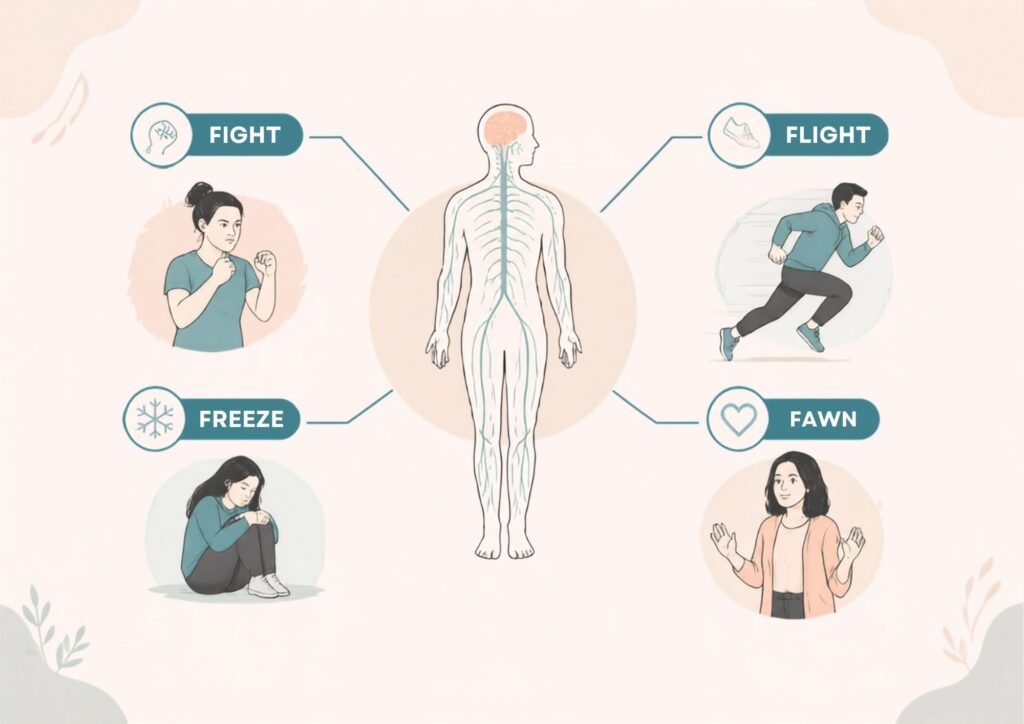
You don’t have to stick with one response for the rest of your life; you could relate to one more than the other, or feel all of them in different situations; that’s all normal.
Somatic work does not try to avoid these responses; instead, it helps you notice them and learn more about yourself with them.
Somatic Work and Anxiety
People have the idea that you first notice anxiety through your emotions and thoughts. However, you usually feel it physically first, like sweaty palms, a lump in your throat, or heavy breathing.
Somatic work can help you learn to notice these physical changes earlier without trying to get rid of them.
For example, you could learn that your palms begin to sweat when you go through something heavy. That would be the first sign of anxiety building up inside your mind, and knowing that gives you some space to choose how to deal with it.
Build Awareness Without Forcing a Specific Emotion
Take time to focus on the present moment and what you are experiencing in that moment. You could be more aware by doing the following:
- Feeling your feet on the floor
- Looking around the room and naming three things you see
- Loosening your hands and shoulders
- Slowing your breath naturally
These are small actions, but they remind your nervous system that you are here, in this moment, and that you are in control.
Somatic Work and Religious Trauma
If you come from a strict religious background, you may have been taught that your body is untrustworthy and your needs are sinful and selfish, that your emotions are wrong and dangerous. So, as you grow up, you may disconnect from your body; that’s normal.
Somatic work doesn’t ask you to trust your body overnight; instead, it may help you rebuild body awareness slowly, on your own terms, without forcing you into anything.
Sometimes healing begins by noticing reactions you’ve learned to ignore, like how tight your chest feels when you hear a certain phrase or how your stomach clenches when you think of something heavy. Just by noticing these signs, you could change a lot for yourself.
Somatic work respects every part of you. It doesn’t criticize your faith or your past. It just guides you to find a way to connect to yourself again after a tough past.

Common Somatic Practices
Grounding
You can ground yourself by focusing on your surroundings: the chair you sit on, the floor below your legs, the table your hands are on. Just notice it and feel it, and you’ll feel more grounded in reality.
Body scanning
Do this by bringing your attention to your body, your legs, arms, head, hands, and face. Notice the sensations you are feeling.
Orienting
Then, begin to look around at your surroundings. Notice the walls, lights, objects, and let your nervous system realize where you are right now, in the present.
Gentle movement
After some time, try a slight movement, like adjusting your posture, getting up, or changing your seat, to let your body move.
Tracking sensations
Finally, notice your 5 senses: smell, touch, taste, sight, and sound. Just keep track of it; that’s enough.
How Walk-and-Talk Therapy Can Support Somatic Awareness
For some people, sitting still in a therapy office makes it difficult to feel and connect to their body. Combining movement with talk therapy can help.
Walk-and-talk therapy is exactly that. In a typical session, you meet with a therapist and go on a walk together outdoors. It still has the same care, respect, and professionalism, just in a different environment.
Walking can help you feel less stuck and more in control. You can ground yourself more in the present moment and notice the sensations you are feeling, which helps you connect with your body naturally.
Obviously, walk-and-talk therapy isn’t made for everyone, like people with physical limitations or those who just prefer the indoors; it is completely valid for them not to want to do it. However, for those who are interested, it could really be a game-changer, and it’s a beautiful way to connect with yourself.
If you are curious, don’t hesitate to talk to your therapist about it and see if walk-and-talk is the right fit for you.

Reflection Prompt
Take a breath and think:
- When you feel pressure to be perfect, where do you notice it in your body?
- Is it in your jaw? Your stomach? Your chest? Your hands?
- What does your body seem to want right now?
- Space? Rest? Grounding? Movement? Support?
- What is one gentle way to listen to your body without judging?
- Don’t overthink it; just take a small step for yourself.
You don’t need to have a proper answer; just let the questions sit with you in your mind. Sometimes, that is enough.
What You Can Do Today
Somatic practice isn’t about forcing your body to behave a certain way or erasing all the tough emotions. It is about learning how to listen to your body and the ways it has been trying to communicate something silently. You do not need to know everything right away. Just acting on your curiosity and asking the questions is the first step.
If this is you, reach out to a therapist for guidance. If you are in Tampa Bay and looking for support with anxiety, perfectionism, religious trauma, or self-worth, Calming Transformations Counseling offers walk-and-talk therapy in Tampa Bay and online therapy in Florida, Idaho, Ohio, South Carolina, and Utah.
More Information About Body-Based Therapy
What is somatic work?
Somatic work is a body-based approach to mental health that helps people notice physical sensations, nervous system responses, and body cues connected to stress, anxiety, trauma, and emotion. Instead of focusing on just the mental aspect, somatic work explores how these experiences show up physically.
How does stress show up in the body?
Stress can show up in a number of ways, including tight shoulders, shallow breathing, stomach discomfort, fatigue, restlessness, numbness, or a racing heart. You may not immediately recognize these as signs of stress, especially if you’ve become used to them. Somatic work can help you become more aware of these patterns and actively change them.
Is somatic work helpful for anxiety?
Yes. Somatic work can help you notice early physical signs of anxiety before your mind recognizes them. Becoming more aware of these signals gives you the time and space to manage them.
What is the difference between somatic work and talk therapy?
While talk therapy is mainly about your thoughts, beliefs and discussing those, somatic work focuses on learning how your body reacts to your thoughts and using your body as the source of knowledge. But one does not necessarily replace the other; the two approaches can work together depending on your needs and goals.
Can walk-and-talk therapy support somatic awareness?
Yes. Walking and talking helps you feel more grounded and aware of your surroundings, which enables you to connect with your body more. Being outside and moving can also make it feel more natural to open up during a therapy session.
About the Author

Chad Thompson, LCSW, is a Licensed Clinical Social Worker providing walk-and-talk therapy in Tampa, Florida, combining the benefits of movement with clinical practices. Telehealth services are also available across Florida, Idaho, Ohio, South Carolina, and Utah. With a unique background in cinema studies and over a decade in hospitality, Chad brings a distinctive storytelling approach to therapy that helps clients see their struggles and growth through new perspectives.
He specializes in faith-based counseling that integrates mental health practices with your personal beliefs. Services also include anxiety therapy, depression treatment, and support for military families. Chad’s warm, authentic style creates a safe space where faith and mental health can work together toward healing.
Contact us today to schedule a session and take the first step toward a more peaceful life.