

Emotions can feel like they’re running the show
One moment you’re fine, and the next you’re overwhelmed by anxiety, anger, or sadness that seems to come from nowhere. If you’ve ever wished you had a pause button between feeling something and reacting to it, you’re not alone. Mindfulness for emotional regulation offers exactly that: a practical way to observe your emotions without being controlled by them.
At Calming Transformations Counseling, we believe you’re the hero of your own story, and every hero needs skills to navigate the hard chapters. Mindfulness isn’t about suppressing what you feel or pretending everything is fine. It’s about building the awareness and tools to respond to your emotions intentionally, rather than being swept away by them.
This article breaks down how mindfulness actually works for emotional regulation, including specific techniques rooted in Dialectical Behavior Therapy (DBT) that therapists use with clients every day. You’ll walk away with exercises you can start practicing immediately, no prior meditation experience required. Whether you’re managing anxiety, processing difficult feelings, or simply want more control over your reactions, these skills can help you rewrite how you respond to life’s challenges.
What mindfulness and emotional regulation mean
Understanding mindfulness for emotional regulation starts with breaking down what each term really means in your daily life. Mindfulness isn’t about becoming a meditation expert or achieving some zen-like state where nothing bothers you. It’s the practice of paying attention to the present moment without judgment, including noticing what you’re feeling, thinking, and experiencing right now. Emotional regulation, on the other hand, is your ability to influence which emotions you have, when you have them, and how you experience and express those feelings. When you combine these two concepts, you create a powerful tool for managing your internal world.
What mindfulness actually is
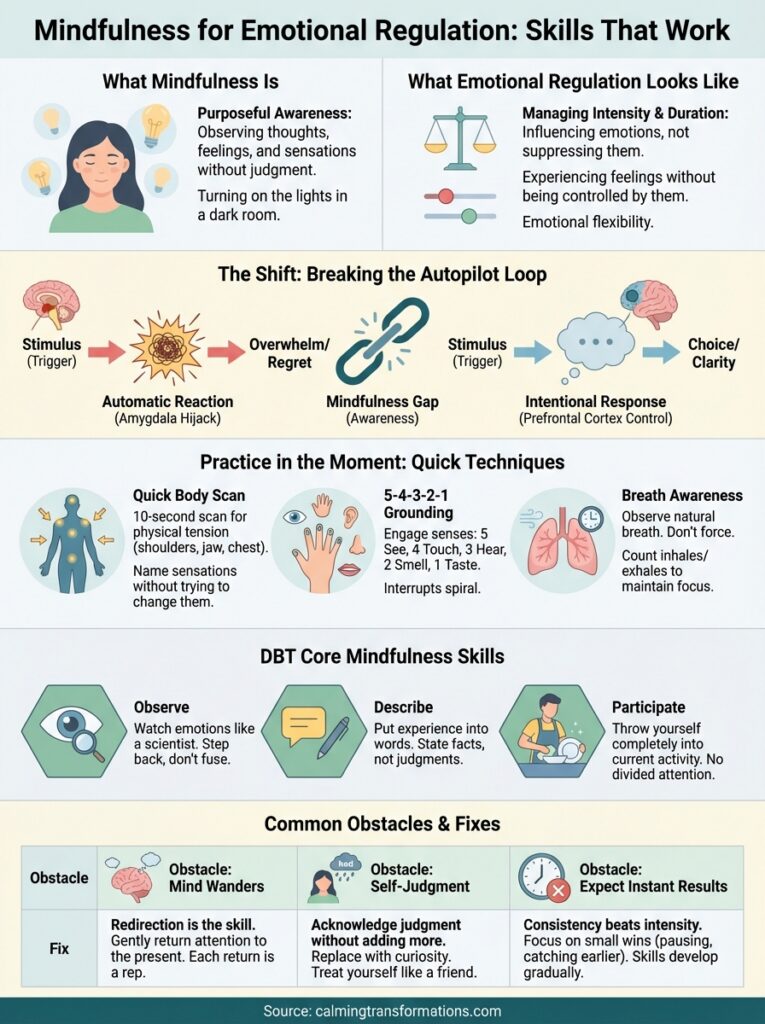
Mindfulness is purposeful awareness of what’s happening inside and around you without trying to change it or judge whether it’s good or bad. You notice your breath moving in and out, the tension in your shoulders, the worry circling through your mind, or the irritation rising in your chest. Instead of getting lost in a story about why you feel a certain way or what it means about you, you simply observe the experience as it unfolds. This isn’t passive acceptance of everything life throws at you. It’s active observation that gives you space between stimulus and response.
Think of mindfulness as turning on the lights in a dark room. You can’t organize or clean what you can’t see. Your emotions don’t disappear when you practice mindfulness, but you become aware of them earlier, before they’ve escalated into overwhelming reactions. That split second of awareness is where your power lives. You might notice your heart racing during a work meeting, your jaw clenching when someone criticizes you, or your thoughts spiraling when you check your phone. These observations become data points rather than automatic triggers.
Mindfulness gives you the ability to catch yourself mid-reaction and choose a different path forward.
What emotional regulation looks like
Emotional regulation is how you manage the intensity and duration of your emotional experiences. It’s not about suppressing feelings or pretending you’re fine when you’re not. Healthy emotional regulation means you can feel anger without throwing things, experience sadness without shutting down for days, or notice anxiety without letting it dictate your decisions. You’re working with your emotions rather than being controlled by them or trying to eliminate them entirely.
When you regulate emotions effectively, you can shift between emotional states as situations require. You might feel frustrated during a difficult conversation but calm yourself enough to communicate clearly. You could feel anxious before a presentation but reduce the intensity enough to perform well. Poor emotional regulation, by contrast, looks like exploding in anger over small inconveniences, staying stuck in depression for weeks, or avoiding any situation that might trigger uncomfortable feelings. You might also swing between extremes, feeling either completely numb or totally overwhelmed with little middle ground.
The goal isn’t emotional perfection or constant happiness. It’s emotional flexibility, the ability to experience the full range of human feelings while maintaining enough control to function, connect with others, and move toward your goals. You learn to ride emotional waves instead of drowning in them or running from them. This skill develops through practice, not through willpower or positive thinking alone.
Why mindfulness changes how you handle emotions
The power of mindfulness for emotional regulation comes down to one fundamental shift: it creates distance between what happens and how you respond. Without mindfulness, you live on autopilot, where triggers automatically generate reactions before your conscious mind even registers what’s happening. Someone criticizes your work, and you’re already defensive. Your partner uses a certain tone, and you’re instantly angry. A text goes unanswered, and anxiety floods your system. Mindfulness breaks this automatic pattern by introducing awareness into the equation, giving you access to choice you didn’t know you had.
The gap between stimulus and response
When you practice noticing your emotions without immediately acting on them, you’re building a crucial buffer between feeling and reacting. This gap might only last a few seconds at first, but those seconds change everything. You feel anger rising after someone cuts you off in traffic, but instead of laying on the horn and tailgating them, you notice your heart racing, your hands gripping the wheel, and the hostile thoughts forming. That moment of observation interrupts the automatic response cycle and allows you to choose differently.
The space between stimulus and response is where your freedom lives.
This isn’t about becoming emotionless or slow to react. You’re training yourself to catch emotions earlier in their development, before they’ve reached the point where they override your judgment. You start recognizing the physical sensations that signal anger, anxiety, or sadness before those emotions fully take hold. Your chest tightens before panic sets in. Your jaw clenches before irritation becomes rage. These early warning signs become opportunities to intervene rather than symptoms you ignore until you’re overwhelmed.
Your brain on mindfulness
Regular mindfulness practice actually changes your brain’s structure and function, particularly in areas responsible for emotional processing. The amygdala, your brain’s alarm system that triggers fight-or-flight responses, shows decreased activity with consistent mindfulness practice. Meanwhile, the prefrontal cortex, which handles reasoning and emotional control, strengthens its connections. This isn’t abstract neuroscience. It means your emotional reactions become less intense and your ability to think clearly during stress improves with practice.

You’re essentially rewiring the pathways between perceiving a threat and responding to it. Instead of your amygdala hijacking your entire system and forcing an immediate reaction, your prefrontal cortex gets more input, allowing you to assess whether the threat is real and choose an appropriate response. This biological change translates into real-world results: you recover from upsets faster, you’re less likely to say things you regret, and you can function effectively even when emotions are present.
How to practice mindfulness in the moment
Practicing mindfulness for emotional regulation doesn’t require you to set aside thirty minutes for meditation or create a perfect zen environment. The most powerful mindfulness happens during actual emotional moments, when you’re stressed at work, frustrated with your partner, or anxious about an upcoming event. These real-time techniques let you interrupt emotional escalation immediately, using your present-moment awareness as an anchor when feelings threaten to pull you under.
Quick body scan technique
Your body holds emotional information before your conscious mind registers it, which makes physical sensations your early warning system. When you notice an emotion starting to build, take ten seconds to scan your body from head to toe. Where do you feel tension? Your shoulders might be hunched, your jaw clenched, your stomach knotted, or your chest tight. Name what you notice without trying to change it: “I feel tightness in my chest” or “My hands are clenched into fists.”
Physical awareness interrupts emotional momentum and brings you back to the present.
This brief body check pulls your attention out of your racing thoughts and grounds it in concrete sensation. You’re not analyzing why you feel this way or what it means. You’re simply observing the physical reality of the emotion in your body. Most people discover that naming the sensation reduces its intensity slightly, creating just enough space to decide what to do next rather than reacting automatically.
The 5-4-3-2-1 grounding method
When emotions feel overwhelming or you’re caught in anxious thoughts, the 5-4-3-2-1 technique forces your attention outward by engaging all five senses. Identify five things you can see around you, four things you can touch or feel, three things you can hear, two things you can smell, and one thing you can taste. This method works because your brain cannot simultaneously panic and focus on sensory details. You’re deliberately shifting from internal emotional chaos to external present-moment observation.
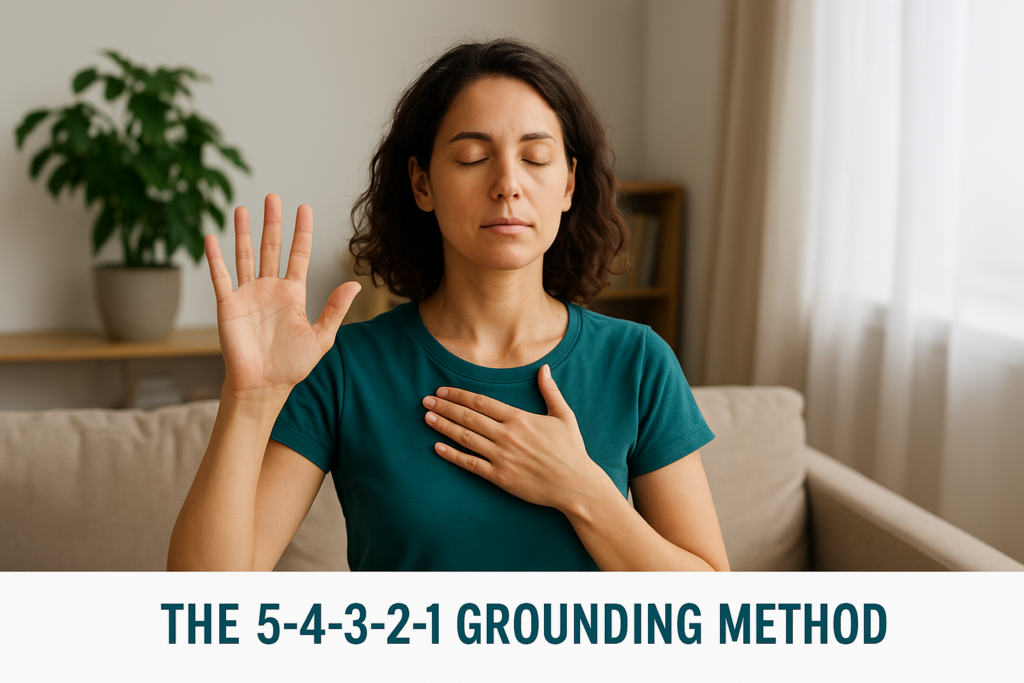
Practice this anywhere: sitting at your desk, standing in line, lying in bed, or walking outside. The act of counting and identifying interrupts rumination and emotional spiraling by giving your mind a specific, manageable task. You don’t need to complete all five senses if your emotion settles earlier. Even reaching the “three things you hear” might be enough to calm your nervous system and regain perspective.
Breath awareness without forcing
Your breath connects directly to your nervous system, making it the most accessible tool for emotional regulation. Instead of trying to breathe deeply or control your breathing pattern, simply notice your breath exactly as it is right now. Is it shallow or deep? Fast or slow? Smooth or choppy? You’re observing without judgment or correction. This neutral observation activates your parasympathetic nervous system, which naturally calms emotional arousal.
Count your breaths if that helps maintain focus: one on the inhale, two on the exhale, continuing to ten before starting over. When your mind wanders to the situation triggering your emotion, acknowledge the thought and return to counting. You’re building the skill of redirecting attention, which becomes your superpower during emotional moments.
DBT mindfulness skills for emotion control
Dialectical Behavior Therapy (DBT) provides three core mindfulness skills specifically designed for emotional regulation: observe, describe, and participate. These skills work together to help you engage with emotions without being overwhelmed by them. Unlike general mindfulness practices, DBT skills give you specific actions to take when emotions threaten to spiral out of control. You can use these techniques individually or combine them depending on what your situation requires.
Observe without judging
The observe skill means watching your emotions like a scientist studies data, without labeling them as good or bad. When anger rises, you notice the heat in your face, the tension in your muscles, and the urge to yell without deciding these sensations make you a bad person. You’re creating distance between yourself and the emotion by treating it as an observable phenomenon rather than your entire identity. This skill prevents you from fusing with your feelings and believing every emotion reflects absolute truth.
Observation transforms overwhelming emotions into information you can work with.
Practice observing by mentally stepping back and narrating what you notice: “I’m experiencing anxiety,” not “I am anxious.” This subtle language shift reminds you that emotions are temporary experiences passing through you, not permanent states that define who you are. You might observe physical sensations, thoughts, urges to act, or changes in your breathing without attempting to change anything immediately.
Describe what you notice
Describing builds on observation by putting your experience into words without adding interpretation or judgment. You state facts about what’s happening: “My heart is racing,” “I’m thinking about the deadline,” or “I feel pressure in my chest.” You’re not saying “This is terrible” or “I can’t handle this.” The distinction between describing and judging makes all the difference for mindfulness for emotional regulation, because judgment intensifies emotions while description keeps them manageable.
Keep your descriptions simple and specific. Instead of “I’m freaking out,” you might say “I’m breathing faster than normal and my thoughts are moving quickly.” This precision grounds you in observable reality rather than catastrophic interpretations of that reality.
Participate fully
Participation means throwing yourself completely into your current activity instead of dividing your attention between what you’re doing and what you’re feeling. When emotions run high, you might wash dishes with full attention to the water temperature, the soap’s texture, and the physical motions rather than ruminating on what upset you. You’re using intentional engagement with the present task to interrupt emotional escalation and give your nervous system time to settle.
This skill works because your brain cannot simultaneously focus intensely on one thing and spiral emotionally about another. You choose an activity and commit fully to it, noticing when your mind wanders to the upsetting situation and gently redirecting to the task at hand.
Common obstacles and how to fix them
Starting mindfulness for emotional regulation sounds easy at first, but once you try it, you might find your mind wandering, emotions feeling more intense, or progress slower than expected. That doesn’t mean you’re doing it wrong or that mindfulness isn’t for you. These are common challenges, and there are simple ways to work through each of them.
Your mind wanders constantly
The most common frustration people report is that their thoughts keep drifting away from the present moment, especially during emotional situations. You start observing your breath during an anxious moment, and three seconds later you’re replaying yesterday’s argument or worrying about tomorrow’s deadline. This wandering isn’t a failure or a sign that mindfulness doesn’t work for you. Your mind is designed to wander, and the actual practice happens when you notice the wandering and redirect your attention back to the present moment.
The skill isn’t staying focused perfectly. It’s catching yourself when you drift and choosing to return.
Treat each return to the present as a successful repetition, like a bicep curl in mental training. You might redirect your attention twenty times in two minutes, and that means you’ve successfully practiced mindfulness twenty times. Start with shorter sessions if sustained focus feels impossible. Ten seconds of full attention builds the foundation for longer periods later.
You judge yourself for having emotions
Many people believe mindfulness means they shouldn’t feel angry, anxious, or sad anymore, so they beat themselves up when emotions still appear. This self-criticism becomes another layer of emotional distress on top of the original feeling. You experience anxiety about an upcoming event, then feel ashamed that you’re anxious, creating a double burden. Mindfulness isn’t about eliminating emotions or achieving permanent calm. It’s about changing your relationship with whatever feelings arise.
When you notice self-judgment appearing, practice the same observation skills you use for other emotions. Acknowledge “I’m judging myself right now” without adding more judgment to that observation. Replace expectations of emotional perfection with curiosity about what you’re experiencing, treating yourself as you would a friend learning a new skill.
You expect instant results
Frustration builds when people practice mindfulness for a few days and don’t see dramatic changes in their emotional responses. You want the panic attacks gone, the anger controlled, and the sadness lifted immediately. Emotional regulation skills develop gradually through consistent practice, not through a single perfect session. Your brain needs time to form new neural pathways and strengthen connections between awareness and response.
Focus on small wins rather than complete transformation: you paused before snapping at your partner, you noticed anxiety five minutes earlier than usual, or you chose a grounding technique instead of spiraling into panic. These incremental improvements compound over weeks and months into significant changes you’ll barely notice until someone points out how differently you’re handling stress.
A simple plan to keep building the skill
Building mindfulness for emotional regulation requires consistent practice, not perfection. Start with one technique from this article and commit to using it daily for two weeks. You might practice the body scan every morning, use the 5-4-3-2-1 grounding method during stressful moments, or spend two minutes observing your breath before bed. Consistency beats intensity when you’re rewiring how your brain handles emotions.
Track your progress by noticing small changes: moments when you pause instead of react, times when you catch emotions earlier, or situations that used to derail you but now feel manageable. These wins prove the skill is developing even when progress feels slow.
If you need professional support while building these skills, Calming Transformations Counseling offers online therapy specifically designed to help you strengthen emotional regulation through evidence-based approaches like DBT. You’re not meant to navigate emotional challenges alone, and working with someone who understands the process can accelerate your progress significantly.