

Hacksaw Ridge is the inspiring true story of Desmond Doss’ wartime courage. It is a powerful portrait of faith under pressure and the remarkable resilience that can emerge from even the most profound pain. His life raises difficult questions about how belief and trauma intertwine, especially for those who serve in the military and struggle to reconcile what they see with what they believe.
How does Desmond’s faith impact his experience in the war?
Doss’s commitment to his beliefs defines every choice he makes. As a Seventh-day Adventist, he refuses to carry a weapon, convinced that his purpose is to save lives rather than take them. In training, this conviction isolates him. His peers ridicule him, question his loyalty, and label him a coward. For anyone who has ever stood firm in their values while others pushed back, these scenes are all too familiar to watch.
His faith does not shield him from fear or loneliness. That is often how conviction works in real life, too. Belief can be a source of strength, but it can also lead to conflict, forcing a person to decide whether their principles still hold when the world around them demands something different.
How does faith shape the experience of trauma?
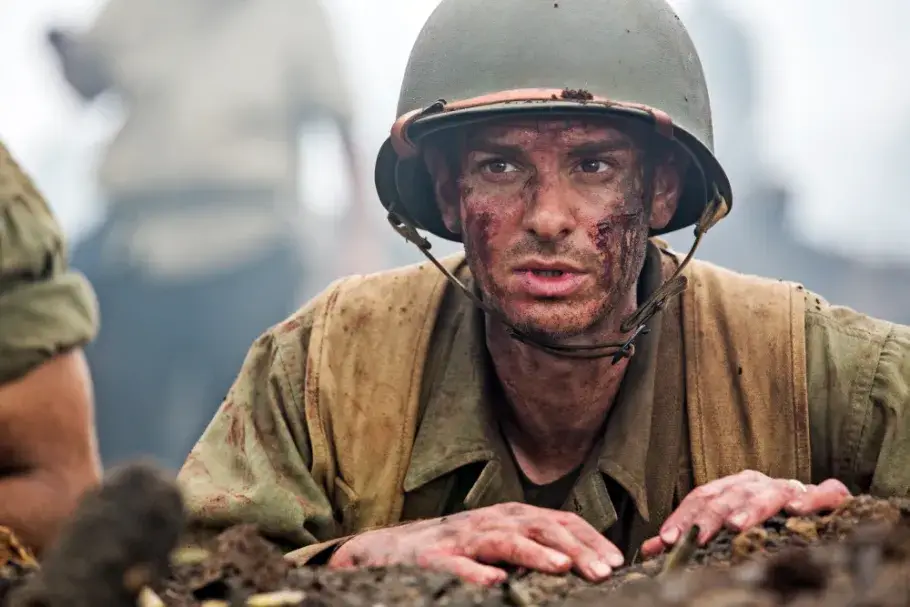
When Doss steps onto the battlefield, his beliefs are tested in ways no one could have prepared for. He witnesses destruction, injury, and loss on a scale few people can comprehend. His quiet prayer, “Please, Lord, help me get one more,” becomes his anchor. Each time he saves another soldier, he gives his pain a purpose.
For many people of faith, trauma can challenge the very foundation of their belief system. They might question where God was in moments of terror or why suffering was allowed to happen. Doss’s story shows that faith does not erase trauma. It coexists with it. His actions are driven by belief, but his fear and exhaustion are undeniably human. Healing for him begins when those two parts of himself are allowed to meet.
Can faith become a source of pain?
Faith can bring peace, but it can also create conflict when it collides with our lives. Religious or moral trauma can occur when someone’s values are shaken by what they have seen or done. In military life, that might mean witnessing harm that violates a person’s moral code. For Doss, the trauma is not only from what he saw but from how those experiences tested the spiritual framework that guided his life.
Healing from this kind of trauma involves more than remembering events. It means rebuilding a sense of connection between belief and experience. In therapy, this often looks like learning to hold space for both pain and faith, without letting one silence the other.
How can meaning help in recovery?
Throughout the film, Doss’s purpose keeps him grounded. Every life he saves is a small act of redemption, a way to make sense of what he cannot control. This sense of purpose is a powerful tool in recovery. When trauma takes away the idea that life has meaning, reconnecting with a guiding belief or mission can help restore balance. For Doss, faith and service become the same thing. His belief moves from words to action. He does not deny what he has seen, but he uses it to strengthen his compassion. This mirrors an important part of trauma healing: finding meaning in what remains, even after the worst has happened.
For Doss, faith and service become the same thing. His belief moves from words to action. He does not deny what he has seen, but he uses it to strengthen his compassion. This mirrors an important part of trauma healing: finding meaning in what remains, even after the worst has happened.
What can his story teach us about healing?
Desmond Doss’s journey shows that faith and trauma are not opposites. They can shape and challenge each other equally. His story invites reflection for anyone who has faced a crisis of belief or identity after a painful experience. Healing might not mean returning to the same faith you once had. It might mean understanding it in a new way.
For those living with religious or military trauma, therapy can be a space to explore both wounds and beliefs with care. Talking through experiences that feel too heavy to carry alone can help create a sense of peace and perspective. Like Doss, many people find that healing begins not in forgetting the past, but in finding a way to live with it: with faith, humility, and strength.
About the Author
Chad Thompson, LCSW, is a Licensed Clinical Social Worker providing Christian Counseling in Tampa, Florida, and telehealth services across Florida, Utah, Idaho, and South Carolina. With a unique background in cinema studies and over a decade in hospitality, Chad brings a distinctive storytelling approach to therapy that helps clients see their struggles and growth through new perspectives. He specializes in faith-based counseling that integrates clinical expertise with Christian values, offering services including anxiety therapy, depression treatment, and support for military families. Chad’s warm, authentic style creates a safe space where faith and mental health can work together toward healing. Learn more about Chad’s approach to Christian Counseling and cinema therapy at Calming Transformations Counseling.
Sessions can be held through online therapy in the states of Florida, Idaho, South Carolina, or Utah. Sessions are also conducted in-office in Riverview, Florida, or via walk-and-talk therapy in Hillsborough County, Florida.
Contact us today to schedule a session and take the first step toward a more peaceful life.